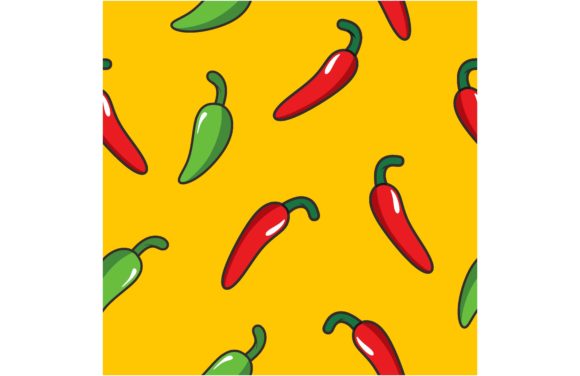
What Makes a Seamless Pattern with Chilli Pepper a Timeless Design Element
Picture a fabric that repeats a vibrant red chilli pepper motif endlessly without a single visible break or awkward join. That uninterrupted flow is the magic of a seamless pattern with chilli pepper. Whether printed on kitchen linens, used as a phone wallpaper, or integrated into high-end fashion, these repeating designs capture attention with their bold colour, organic shapes, and the warm cultural associations chillies carry. But there is far more to this design technique than simply copying and pasting an illustration. Understanding how seamless patterns work opens up a world of creative possibility—and the chilli pepper happens to be one of the most versatile subjects a designer can choose.
Understanding Seamless Patterns at Their Core
Before exploring why chillies make such compelling pattern subjects, it helps to understand what a seamless pattern actually is. In design terminology, a seamless pattern—also called a repeat pattern or tileable texture—refers to an image that can be duplicated and placed side by side in any direction without visible edges, gaps, or interruptions. The left edge blends perfectly into the right edge, and the top edge connects flawlessly to the bottom. This creates an illusion of infinite continuity.
The mathematical precision behind seamless repeats has roots in textile production dating back centuries. Early block-printed fabrics from India and intricate silk weavings from China relied on artisans who understood how motifs needed to align for continuous yardage. Today, digital tools like Adobe Illustrator, Procreate, and specialized pattern-making software have made the technical side far more accessible, but the core principle remains unchanged: every element that touches one edge must have a corresponding element at the opposite edge.
Why "Seamless" Matters More Than You Think
When a pattern has visible seams, the human eye detects the disruption almost instantly. A slight misalignment registers as a flaw, breaking the immersion a designer intended. Seamless patterns eliminate this problem entirely, which explains why they dominate industries ranging from interior décor to web design. A seamless pattern with chilli pepper used on a website background, for instance, can scroll infinitely without jarring the viewer. On a dress, the pattern flows naturally around curves and seams in the garment itself. The seamlessness of the print becomes a functional necessity, not just an aesthetic preference.
The Chilli Pepper as a Design Subject: More Than Just Heat
Chilli peppers bring a unique combination of visual appeal and cultural meaning to pattern design. Their elongated forms, curved silhouettes, and vibrant colour gradients—from deep crimson reds to sunny yellows and rich greens—offer organic shapes that work beautifully in repeating arrangements. Unlike perfectly geometric motifs, chillies introduce a sense of movement and life. A well-designed chilli pepper pattern can feel playful, rustic, elegant, or even edgy, depending on the illustration style and colour palette chosen.
Beyond aesthetics, chillies carry rich symbolism across cultures. In Mexican folk art, they represent warmth, hospitality, and the vibrancy of everyday life. In Italian and Mediterranean design traditions, strings of dried red chillies—known as peperoncini—symbolize abundance and good fortune. Korean, Thai, and Indian visual cultures also feature chillies prominently, associating them with bold flavours and communal dining. A seamless pattern with chilli pepper taps into these layers of meaning, making the design resonate on an emotional level that purely abstract patterns rarely achieve.
Practical Applications Across Industries
The versatility of chilli pepper seamless patterns extends far beyond the obvious culinary contexts. Understanding where and how these patterns get used reveals just how embedded they are in modern visual culture.
Textile and Fashion Design
Fashion brands regularly incorporate chilli motifs into seasonal collections. Summer dresses, casual button-down shirts, and accessories like scarves and tote bags benefit from the lively energy chillies project. The seamless nature of the pattern ensures that garment construction—cutting fabric pieces from different parts of the printed yardage—does not create mismatched joins. Designers working with print-on-demand services often choose chilli patterns for their broad consumer appeal and the ease with which the seamless tile integrates into product templates.
Home Décor and Interior Design
From kitchen wallpaper to upholstery fabric on dining chairs, chilli patterns inject personality into living spaces. A subtle, watercolour-style seamless pattern with chilli pepper can add sophistication to a neutral kitchen, while a bold, graphic version might anchor a maximalist dining room. Removable wallpapers and peel-and-stick tiles featuring seamless chilli designs have grown particularly popular among renters seeking temporary but impactful décor updates.
Digital Products and Branding
In the digital realm, seamless chilli patterns appear as website backgrounds, social media templates, digital scrapbooking papers, and app interface elements. Food bloggers and hot sauce brands frequently use these patterns to reinforce their visual identity. Because the pattern tiles infinitely, it adapts effortlessly to different screen sizes and aspect ratios—an important consideration in responsive web design.
Packaging and Product Design
Artisanal food producers, spice companies, and gourmet gift brands leverage chilli patterns on labels, boxes, and wrapping paper. The seamless quality allows designers to apply the pattern to packages of varying dimensions without worrying about awkward cut-offs. A small jar label and a large gift box can feature the same pattern tile, scaled appropriately, and both will look intentionally designed.
How Designers Create a Seamless Pattern with Chilli Pepper
For readers curious about the creation process, the workflow typically follows a structured sequence. While every designer develops personal techniques, the fundamental steps remain consistent across most projects.
- Concept and sketching. The designer begins by sketching chilli pepper illustrations—whole peppers, sliced cross-sections, leaves, stems, and perhaps complementary elements like garlic bulbs or herb sprigs. The style choice at this stage shapes the entire pattern's personality. Realistic botanical illustrations create a different feel than flat, minimalist vector icons.
- Digitizing the artwork. Sketches move into vector software or raster editing programs. Vector formats (like those created in Adobe Illustrator) offer infinite scalability, making them ideal for patterns destined for both tiny labels and large-format prints.
- Arranging the tile. The designer places motifs within a square or rectangular bounding area, paying careful attention to the edges. Elements that cross the left edge must reappear at the same vertical position on the right edge. The same rule applies to the top and bottom edges. Most professional software includes pattern-making tools that automate much of this alignment work.
- Testing the repeat. The tile gets tested by creating a grid of duplicates and examining the intersections for visible seams, awkward gaps, or unintended clusters of elements. Designers often adjust spacing, rotation, and scale during this phase to achieve a balanced distribution of visual weight.
- Colour refinement. The final palette gets locked in, with attention to how colours interact when repeated at scale. A pattern that looks harmonious as a single tile can feel overwhelming when repeated across a large surface if colours are too intense or contrast ratios are too high.
Common Misunderstandings About Pattern Licensing and Usage
One area where newcomers often stumble involves the usage rights attached to seamless patterns. Finding a beautiful seamless pattern with chilli pepper online does not automatically grant permission to use it commercially. Patterns carry licenses that range from personal use only to full commercial rights. Designers selling on platforms like Creative Market, Etsy, or Spoonflower typically specify allowed uses clearly.
Additionally, some assume that altering a pattern—changing its colours, for instance—frees them from licensing obligations. This is legally incorrect. The underlying artwork remains protected, and modifications do not constitute original creation. For business owners and content creators, investing in properly licensed patterns or commissioning original designs from freelance illustrators avoids legal complications and supports the creative ecosystem.
Cultural Appreciation Versus Appropriation in Chilli Imagery
Chilli peppers carry significant cultural weight in many communities, and designers working with these motifs benefit from approaching the subject thoughtfully. Using chilli imagery in ways that honour the cultural traditions associated with the ingredient—Mexican papel picado aesthetics, Mediterranean string-drying techniques, or Korean gochujang culture—can celebrate shared culinary heritage. On the other hand, reducing cultural symbols to hollow decoration without acknowledging their origins risks alienating the very audiences who find those symbols meaningful.
Responsible pattern designers often research the cultural contexts of their chosen motifs and collaborate with artists from the relevant communities. This not only enriches the design outcome but also strengthens the narrative behind the pattern, creating more authentic and compelling products.
Why Chilli Pepper Patterns Continue to Trend
Design trends cycle constantly, yet chilli motifs maintain remarkable staying power. Several factors contribute to this longevity. First, the global popularity of spicy cuisine shows no signs of waning. As food cultures blend and travel broadens palates, chillies remain a universal symbol of flavour exploration. Second, the colour red—dominant in most chilli patterns—carries strong visual impact and works across virtually every design context. Third, the organic, slightly unpredictable shapes of chillies soften the rigidity that purely geometric patterns can impose, making them suitable for both contemporary minimalist interiors and cozy, traditional spaces.
The rise of sustainable and handmade aesthetics has also favoured botanical motifs. Consumers increasingly seek products that feel personal and connected to nature. A seamless pattern with chilli pepper bridges the gap between cultivated design and natural inspiration, meeting that demand effectively.
Choosing the Right Chilli Pattern for Your Project
With countless variations available, selecting the ideal chilli pattern involves considering several practical factors. Scale matters enormously. A large-scale pattern with oversized chillies commands attention and works best on statement pieces like feature walls or bold garments. Small-scale patterns, where chillies appear as delicate repeats, suit subtle backgrounds and smaller products like stationery or accessories.
Colour palette also determines versatility. Monochromatic or neutral-toned chilli patterns integrate easily into existing colour schemes, while vibrant, multicoloured versions become the focal point of any design. The illustration style—photorealistic, watercolour, line art, or flat vector—communicates different brand personalities and aesthetic sensibilities.
- Watercolour chillies evoke artisanal, handmade warmth and suit organic food brands or rustic home décor.
- Flat vector chillies feel modern and clean, perfect for tech interfaces or contemporary branding.
- Line art chillies offer elegance with restraint and work beautifully on packaging and stationery.
- Photorealistic chillies maximize visual impact and suit bold fashion statements or immersive interior murals.
Building a Broader Understanding of Pattern Design
Exploring a single motif like the chilli pepper opens a door into the wider discipline of surface pattern design. The principles governing seamless repeats—edge alignment, balanced composition, scale variation, and colour harmony—apply universally across all pattern subjects. Florals, geometrics, abstract textures, and illustrated narratives all follow the same foundational rules. Mastering these through a focused subject like chillies builds transferable skills applicable to countless creative and commercial projects.
For those interested in creating their own patterns, beginning with a recognizable, relatively simple shape like a chilli pepper offers an accessible entry point. The elongated form provides clear directional energy, the colour palette is intuitive, and the organic curves forgive slight imperfections that might be glaring in purely geometric designs. Many professional surface pattern designers recall their first successful repeat pattern featuring botanical subjects precisely because plants offer forgiving, flowing shapes to work with.
Whether encountered on a tablecloth in a sunlit kitchen, a summer dress at a market, or the packaging of an artisanal hot sauce, a well-executed seamless pattern with chilli pepper represents the intersection of mathematical precision and creative expression. It reminds viewers that good design often hides its complexity behind an effortless, joyful appearance—much like the perfect dish seasoned with just the right amount of heat.