The Quiet Power of a One Line Seamless Pattern in Everyday Design
There's something almost meditative about watching a single unbroken line weave its way across a surface, never lifting, never stopping, just flowing. A one line seamless pattern captures exactly that feeling and turns it into something you can use practically anywhere. It's a continuous line drawing that repeats infinitely without visible breaks or awkward joins, creating a surface design that feels both organic and intentional. Designers, makers, and brand owners have been quietly embracing this style because it solves a very specific problem—how to add character without adding noise.
But beyond the technical definition, the real value lies in how this kind of pattern behaves in the wild. It sits differently on a phone case than it does on a linen cushion. It shifts personality when you scale it up for wallpaper versus when you shrink it down for a thank-you card. Understanding where and why it works can completely change how you think about using it.
Where a Single Continuous Line Changes Everything
Most people stumble upon one line seamless pattern designs while hunting for something minimal but not boring. That's the sweet spot. You want a background that has movement, maybe even a bit of whimsy, but you don't want it screaming for attention. This is where the continuous line aesthetic really earns its keep.
Think about fabric first. A dressmaker choosing a cotton print for a summer collection might be torn between bold florals and simple stripes. A one line botanical motif, say a vine that never breaks as it loops and curls, gives the garment flow without committing to a loud statement. The uninterrupted nature of the line guides the eye around the body's contours naturally, which is something blocky geometric prints sometimes fail to do. Quilters have latched onto this too—the seamless aspect means patterns can be cut and pieced without worrying about mismatched edges destroying the visual rhythm.
In stationery, the appeal shifts slightly. Wedding invitation suites often use delicate one line illustrations of the couple's venue or a meaningful flower, and making that illustration repeat seamlessly across a vellum wrap or envelope liner turns a lovely detail into an immersive experience. The one line seamless pattern here isn't just decoration; it's storytelling that unfolds every time someone handles the paper.
Digital Spaces and the Scroll Factor
Website backgrounds live or die by how they handle repetition. Nobody wants to spot the tile edge while they're reading about your services. A well-constructed seamless pattern disappears into the experience, and the one line style has an advantage here because the eye naturally follows curves rather than hunting for grid lines. Wellness coaches, therapists, and yoga instructors often gravitate toward these patterns for their sites because the unbroken line subtly communicates continuity and calm.
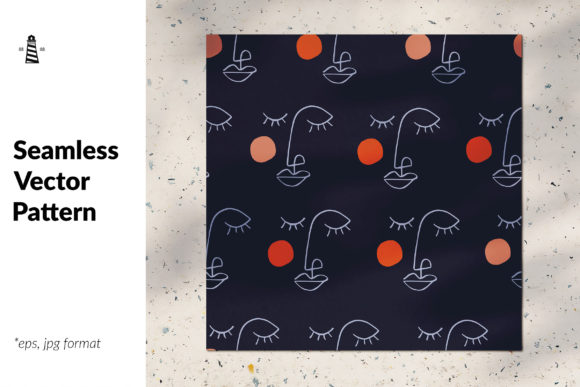
Social media templates are another quiet powerhouse for this design approach. An Instagram story background using a one line seamless pattern keeps things interesting without competing with the text overlay. A life coach might use a soft terracotta background with a single continuous line forming abstract faces or hands—just enough texture to feel considered, never enough to distract. The key is that the line feels human. It carries the slight wobble or intentional imperfection that stock geometric patterns lack.
App designers have also started incorporating these textures into onboarding screens and loading states. When you're waiting three seconds for content to populate, a gentle flowing line animation built from a seamless repeat can actually lower that tiny spike of user frustration. It's subtle psychology, but it works.
Product Surfaces and Tactile Impressions
Physical products live and die by touch and close-up inspection. A ceramic mug with a one line face pattern that wraps seamlessly around the curve feels like a small piece of art you can hold. The magic is in the lack of a start or end point—the line just keeps going, and your thumb traces it absentmindedly while you sip your coffee.
Phone case manufacturers have caught onto this in a big way. Cases are high-touch items that get stared at hundreds of times a day. A one line seamless pattern scaled to case dimensions creates a kind of personal talisman—abstract enough to not feel trendy, distinctive enough to get comments. Some makers are experimenting with debossing these line patterns into leather cases, which adds a tactile dimension that printed patterns can't offer.
Packaging design is another space where this approach solves real problems. Small brands selling candles, skincare, or artisan foods often need their packaging to feel premium without the premium price tag. A simple kraft box with a one line seamless motif printed in white or gold ink looks intentionally minimal, not cheap. The seamless nature means whatever size box or bag you're printing on, the pattern flows naturally around corners and seams without awkward cut-offs.
Interior Applications and Scale Sensitivity
This is where things get interesting. A one line seamless pattern behaves completely differently at wallpaper scale than at cushion scale. A continuous line drawing of abstract landscapes or body forms spanning an entire feature wall can feel almost mural-like, but because it repeats, you don't have the expense or commitment of a custom painted mural. The seamless repeat, when done well, creates a rhythm that feels intentional rather than repetitive.
Interior designers working in hospitality and retail spaces have been using oversized one line patterns to define zones within open-plan areas. A café might use a bold black line pattern on one wall near the counter, pulling the eye toward the order point without needing signage. The continuous line feels modern and a little artistic, which subtly elevates the perceived quality of the space.
Curtain and upholstery fabrics benefit differently. Because soft furnishings fold and drape, the pattern gets naturally distorted. A one line design handles this distortion more gracefully than rigid geometric repeats. The organic flow already has bends and curves, so a fold in the fabric just adds to the movement rather than breaking the illusion. It's why you're seeing more of these patterns on velvet cushions and linen throws in boutique homeware stores.
Considering the Practical Side Before You Commit
For all their charm, one line seamless patterns do come with considerations worth chewing on before you go all in. The biggest one is density. A very dense continuous line repeat can look stunning as a swatch but overwhelming across a large surface. What felt like delicate tracery in a six-by-six inch sample might read as visual static on a king-size duvet cover. The fix isn't to abandon the idea but to pay close attention to line weight and spacing at full scale.
Color is another factor that behaves differently with this style. Many one line patterns shine in monochrome—black on cream, white on navy, gold on forest green. But introducing multiple colors to a single continuous line requires careful plotting or you risk losing the "one line" illusion entirely. Some designers cheat cleverly here by using gradients that shift color along the same unbroken path, and that can look spectacular when done right.
Licensing and creation tools also deserve a mention. If you're sourcing rather than creating, look carefully at the seamless repeat quality before purchasing. A one line seamless pattern that doesn't actually tile perfectly loses its core advantage. Many marketplaces let you preview the repeat grid, and it's worth zooming in on those edges. For makers who want to create their own, vector-based tools like Adobe Illustrator or Affinity Designer with their pattern-making features are the standard path, and there are plenty of creators sharing their process online if you want to learn the workflow.
Different Audiences, Different Attractions
Not everyone comes to this design style for the same reason, and that's what keeps it so versatile. Surface pattern designers might be drawn to the technical challenge of maintaining a single line while still creating visual interest across a repeat. There's a puzzle-like satisfaction to routing that line so it never crosses itself awkwardly and still reads as a pattern at distance.
Brand strategists tend to value the narrative potential instead. A skincare line using a one line seamless botanical pattern can talk about "simplicity," "purity," and "no unnecessary ingredients" without saying a word—the unbroken visual line mirrors those values perfectly. Coaches and consultants might use abstract one line patterns as a visual metaphor for clarity, focus, or the client journey from confusion to insight.
DIY and craft communities have their own relationship with it. Cricut and Silhouette users love one line designs because they cut cleanly and transfer well onto everything from wine glasses to t-shirts. The one line seamless pattern format means they can scale and repeat the design to fit any project surface without manually copying and aligning. It's a practical time-saver that also happens to look great.
When It Shines and When Something Else Might Work Better
There's no design solution that fits every single situation, and honest reflection on where this pattern style excels—and where it might struggle—helps you make better choices. The style absolutely thrives in contexts where you want the design to feel effortless and unforced. Brands positioning themselves as approachable, human-centered, or artisanal often find their visual match here. Products that benefit from a handcrafted feel without actually being handmade use this aesthetic to bridge that gap convincingly.
The limitations mostly show up in extremely data-dense or technically formal contexts. A one line seamless pattern probably isn't your best bet for a financial services annual report or a medical device interface where absolute visual clarity trumps aesthetic warmth. The organic irregularity that makes the pattern feel human can also make it feel less precise, and sometimes precision is non-negotiable. That said, a very restrained application—perhaps inside a folder or as a subtle section divider—can still work in corporate settings if the line is clean and the scale is modest.
Ultimately, the beauty of this design approach is its flexibility. The same core concept can produce vastly different results depending on subject matter, line weight, spacing, color, and application surface. A continuous line pattern of abstract geometric shapes feels entirely different from one depicting faces, hands, or botanicals. That range means the one line seamless pattern isn't really one look at all—it's a technique that can adapt to nearly any visual personality you're trying to communicate, provided you take the time to match the specifics to the context.